Most people we work with hate cutting their plants. It feels like undoing months of growth. But an unpruned balcony plant does not become a bigger, better version of itself. It becomes a tall bare stem with a tuft of leaves at the top, flowering less each season, with a tangle in the middle where pests hide. Pruning is how you keep a potted plant compact, full and flowering. Here is where to cut, and when.
Why cutting makes a plant fuller
Most plants grow from the tip, and the growing tip holds back the buds lower down the stem. Cut the tip off and those lower buds wake up, so one stem becomes two or three. This is why a pinched tulsi bushes out and an unpinched one shoots straight up and flowers itself out. In a pot, where the roots have limited room, a smaller and denser plant is also a healthier one. It has fewer leaves to keep watered in May, less top weight to catch the wind on a high floor, and more light reaching the inner stems, where pests like to settle.
Where to cut
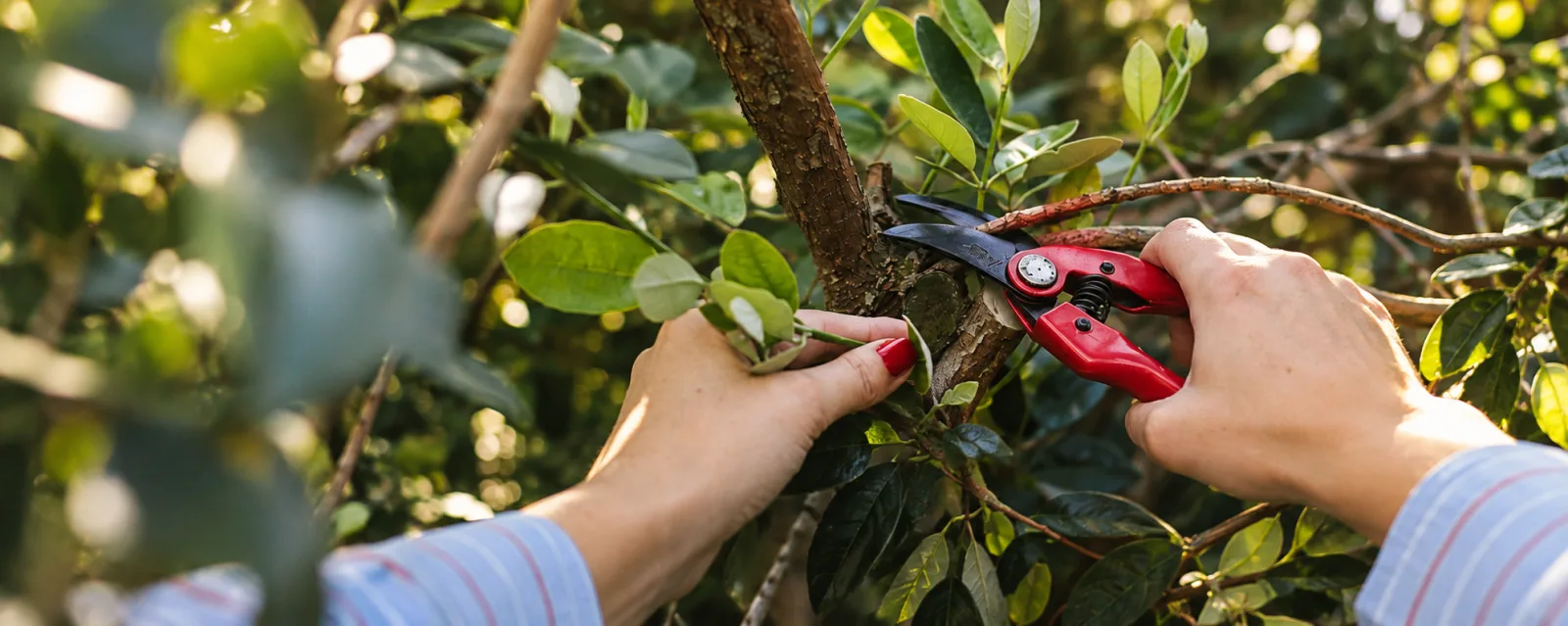
Find a node: the small bump on the stem where a leaf joins, or used to. Cut about a quarter of an inch above it, at a slight angle sloping away from the bud. Too close and you damage the bud. Too far above and you leave a stub that dies back and invites rot. Choose a node whose bud faces outwards, so the new shoot grows away from the centre of the plant rather than into it.
Use sharp secateurs, not kitchen scissors. A clean cut seals within days; a crushed one does not. Wipe the blades with rubbing alcohol between plants, especially after cutting anything diseased. For soft herbs and money plant, clean fingers are enough: pinch the tip out between thumbnail and finger. For woody stems thicker than a pencil, such as an old bougainvillea, use loppers or a small pruning saw rather than forcing the secateurs.
Never take off more than a third of a plant in one go. If it needs more, do it in two sessions a month apart, and water normally in between.
When to cut, by type of plant
Timing depends on how the plant flowers. Bougainvillea, hibiscus and tecoma flower on new growth, so a trim after each flush of flowers brings the next flush sooner. Their main shaping cut is best in February, or after the monsoon in October. Jasmine, including mogra, wants its hard prune in late winter, January to February, before it flowers in the summer heat. Herbs such as basil, mint and tulsi want their tips pinched every week or two, all year.
Foliage plants such as money plant, rubber plant and philodendron can be cut at almost any time outside peak heat. Avoid heavy pruning in April and May, when a heat-stressed plant cannot afford to lose leaves, and during Delhi's December and January cold, when it will not regrow until spring.
A simple pruning routine
What to cut, and how often
5 thingsCuttings are not waste. Money plant, coleus, hibiscus and bougainvillea will root from a 6-inch piece of stem in water or moist cocopeat, some within a few weeks, the woody ones more slowly. That is how many of our customers end up with spare plants to give to neighbours. Strip the lower leaves, keep the cutting out of direct sun, and pot it up once the roots are about an inch long.