In most Indian cities the balcony gets used most after 7 pm, once the heat has gone. Yet on many balconies we visit there is a single tube light or a bright white bulb on the ceiling that flattens everything and draws every insect in the building. Good evening light does not need rewiring the flat. It needs three layers, a warm colour temperature, and a little care about where each lamp points.
Start with warm light
Colour temperature is measured in kelvin and printed on the box. For a balcony you want warm white, 2700 to 3000 K: the soft yellow of an old filament bulb. Cool white and daylight bulbs, 4000 K and above, make plants look grey, faces look tired, and the space feel like a corridor. In our experience warm light also pulls in fewer insects than cool white, though nothing keeps them away entirely. Check the box before you buy: the kelvin figure matters more than the wattage, and one warm bulb is better than three cool ones.
Three layers of light
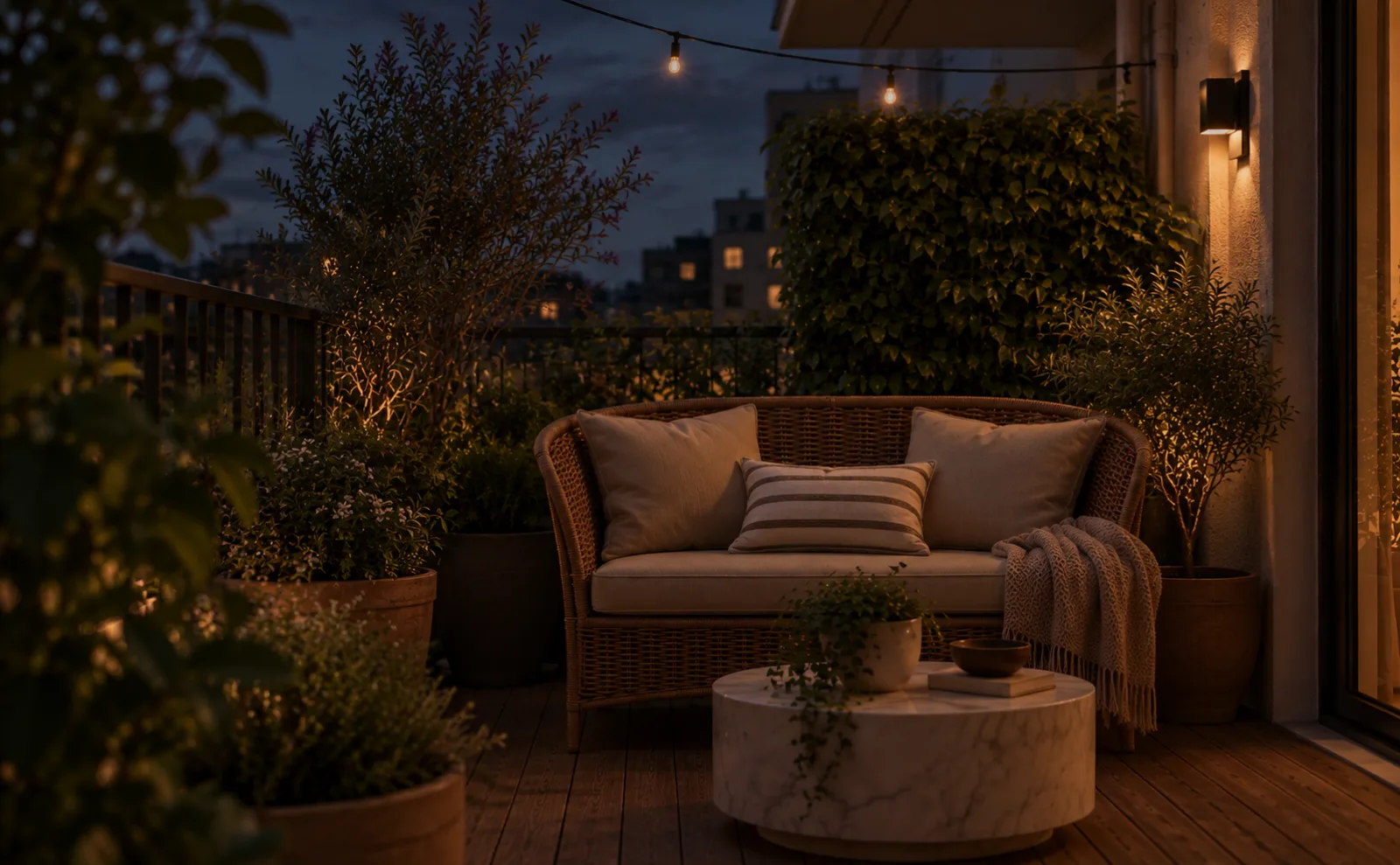
The first layer is ambient: a soft general glow so you can see the space. Festoon or string lights along the ceiling or railing do this well, hung in gentle swags rather than pulled tight. The second is accent: one small spotlight that uplights a plant from its base. A palm, an olive or a bougainvillea throws leaf shadows onto the ceiling and makes a small balcony feel deeper. The third is safety: low wall or step lights near the door, any change of level and the tap.
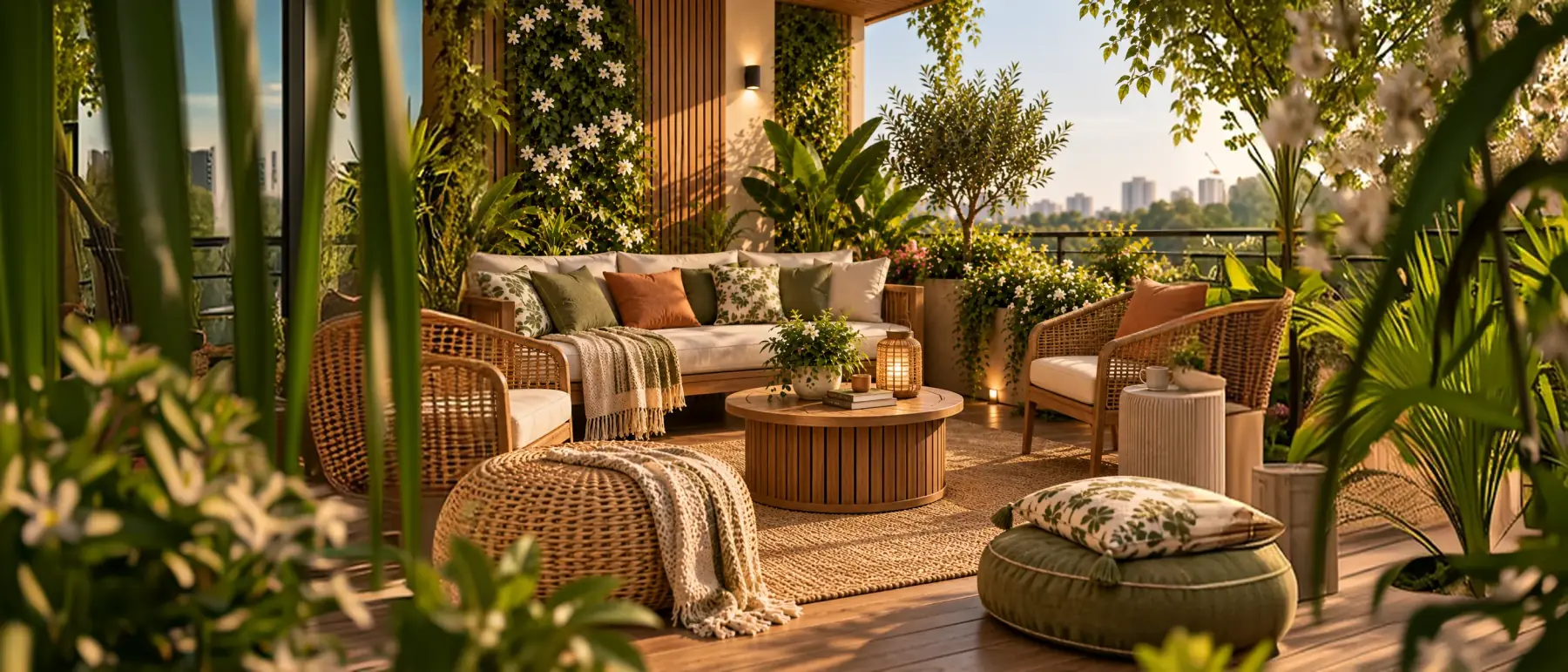
You do not need all three at once. Put each layer on its own switch or plug, so you can use the festoon alone on a quiet evening and add the rest when people are over. Start with the festoon, live with it for a week, then decide where the uplight should go. On most small balconies two layers are plenty; the step lights matter most where there is a raised threshold or children about.
Uplight one plant, not every plant. A single lit palm in a corner does more than six spotlights scattered across the floor.
Where not to point a lamp
Never aim a light straight out from the balcony. It glares into the neighbours' windows and turns your balcony into a lit stage for the street. Point spotlights up into foliage or against a wall. Do not put a bare bulb at eye level where you sit; hide the source behind a planter or choose a frosted, diffused fitting. Avoid lighting glass railings head on, because the reflection hides the view you are trying to enjoy.
Weatherproofing, solar and timers
Anything outdoors needs an IP rating. IP44 is enough for a covered balcony where a light only sees splashes. For anything the rain reaches, especially in Mumbai's monsoon, choose IP65 or higher. Use outdoor-rated plugs and keep connections off the floor, where water collects. If running a cable is not possible, solar spike lights push into a pot and charge by day. They work well on a west or south-facing balcony; on a shaded north balcony they barely glow.
Finally, a simple plug-in timer. Set it to switch the festoon on at dusk and off at 11 pm, so nothing burns all night and nobody has to remember. Adjust it twice a year, since dusk comes an hour or more earlier in December than in June. Plants need their dark hours too, and a spotlight left on all night on the same leaves does them no favours.